You’d think Glenn De Jongh (nee Glen Crimson) ought to be a jaded man.
In the 12 years leading up to 1991, he founded many outfits: the Spiffs, The Urge, Another Pretty Face, Wall Street, and Bob. At one brief point he burned out and swore off music. He put on the suit. He rose early each day and worked as a stockbroker at a Phoenix securities firm. Then ex-Fleetwood Mac man Bob Welch phoned him about playing bass in his new backing band, Avenue M. That band toured and recorded. Welch and De Jongh became close friends, but not close enough to record De Jongh’s songs. “I remember him telling me, ‘we’re doing my songs, only my songs, I’m the one with platinum records.’” After a couple years, De Jongh split. At least he got a song credit on Rhino’s Best of Bob Welch.
De Jongh wanted to play his own songs. “I left that band… I auditioned guys. The Cherries were born around 1991.” Welch later moved to Nashville. Years later, he died by suicide.
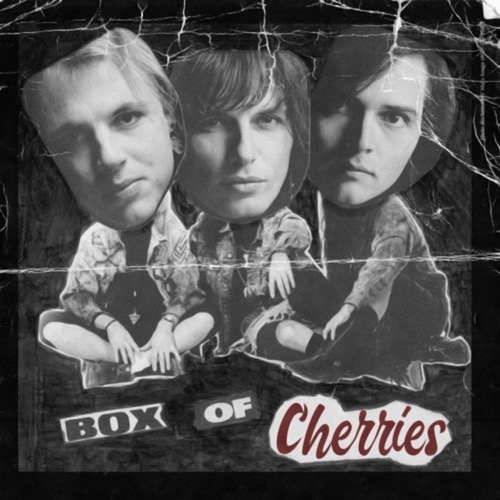
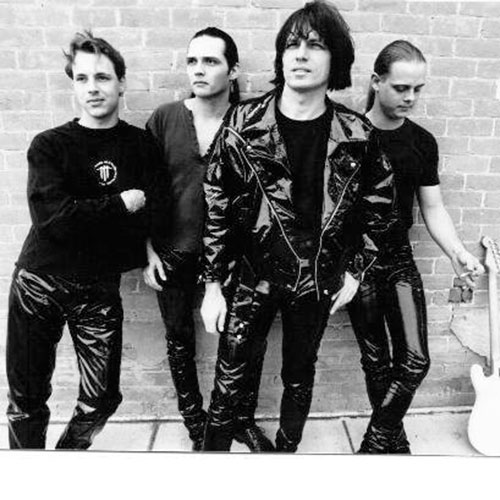
Box of Cherries’ cast included core bassist Geno Arce and drummer Dave Marshall, guitarists Tommy McNeely and Amos Cox, with singer De Jongh now on guitar. They were a weirdly poppy hard-rock quartet, outfitted in the era’s transitional garb—a mix of Sunset Strip and thrift-store grunge—yet the songs, beneath the hair flips and star-gazing (and the occasional disco beat), were well-written hookfests. They drew large crowds in Phoenix and L.A. clubs.
De Jongh is nothing if not a scrappy self-promoter whose mad shenanigans overshadowed those hookfests. Tales of 6 a.m. radio-station parking-lot stunts involving the band and exotic dancers, or picketing Warner, Geffen and Capitol with home-made signs basically demanding a record deal. Once, De Jongh and the band sat behind a wall of ecdysiasts, all derrieres and lingerie, for a band promo shot. Needless to say, the press, label suits and club owners were hardly thrilled.
They’d befriended Geordie Hormel, the oddball heir to the Spam fortune, and played and stayed inside his mansion (“it had 23 bathrooms!”). The manor included a recording studio headed by golden-eared engineer Jeff Harris (Supertramp, Warren Zevon, George Benson). Hormel, a musician/composer himself, had founded the legendary Village Recorders in LA.
De Jongh remembers decades later how Hormel dropped into his cherry box. “This sick beautiful woman came up and said, ‘would you like to play a party?’ So we played the party. It was in the ice-skating rink inside the Hormel mansion.”
Hormel and Harris believed in Box of Cherries, and the band recorded at the home’s state-of-the-art studio. De Jongh continues: “I lived there on and off for the next three years. The cook and butler would cook my food and do my laundry. When I got there my guitars were in hock. We stayed at their place in the [Pacific] Palisades, this gated thing, whenever we played in LA. They bought us a used van. When that one broke down they bought us another one.”
The Box of Cherries songs, recorded with Jeff Harris at Hormel, were acquired and assembled in recent years by Fervor Records as a self-titled mini-album. The collection is an assured and articulate snapshot of hard-rock time and place.
“Love in Your Pocket” rides De Jongh’s self-effacing spoken-word asides about a sentimental fool, unattainable women, Circle K runs and locket charms, topped off by a giant chorus that’s all Rick Springfield. “Hippy Crack” spoofs nitrous balloon enthusiasts with big drum hooks, a ska-influenced bridge and a tooth-decaying refrain of yeah-yeah-yeahs while “That’s That” and “IOU” twist Montrose-styled riffs into something befitting early ’70s FM radio.
The kinetic live show too, all arena-ready bravado and belief, could’ve been a mad draw on the Jersey Shore, kicking out surging blasts as if global stardom were one record exec away.
Well, the band did win a ballyhooed Arizona Battle of the Bands hosted by Z-Rock radio. Warner Brothers A&R man Barry Squire judged and introduced Box of Cherries to his label. After three meetings, nada. Squire told frontman De Jongh, then in his 30s, he was too old. Squire soon brought Green Day to Reprise/Warner. The rest is history.
Note that Green Day ended Box of Cherries, like Nirvana killed Poison. Sort of. After hearing Dookie, De Jongh and the Cherries lopped their locks, became the Einsteins and returned to the punk-pop he’d played in the Spiffs a decade and a half earlier.
– Liner notes by Brian Jabas Smith