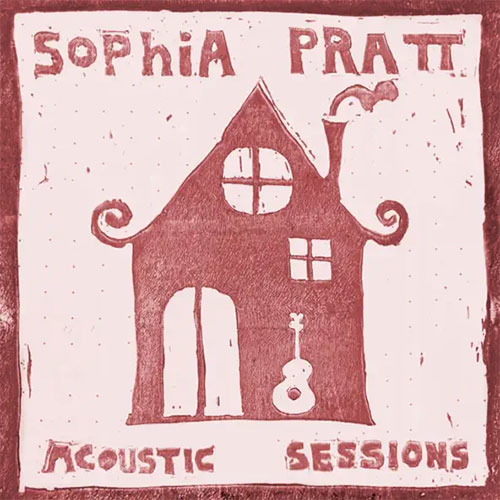

It makes sense Sophia Pratt has an Elliot Smith phone case made from a concert poster. It’s bittersweet kismet she discovered tragic Laurel Canyon songbird Judee Sill had lived a street away in her North Hollywood neighborhood decades earlier. “And I was on a Judee Sill deep dive,” she says.
Smith killed himself and Sill died of an overdose, and both were as emotionally giving as can ever be expected in any kind of song. Pratt’s songwriting, music and recordings draw from similar emotional wells, where sentimentality isn’t a pejorative, where dreaming and nostalgia and heartbreak and elation come together, leaving traces of melancholy.
“I think [song]writers take up that emotional space,” Pratt says. “I feel my feelings very deeply so I’ve been attracted to music like that in a similar way. I don’t think I’m suffering sadness in my life, it’s more about the most poignant times in our lives. Just navigating through relationships, just being a person in this world right now. Connection is difficult.”
The act of writing a song may be willful, but what pushes the notes is not. Pratt doesn’t sit down to write sadness or beauty. It just is: scrawled-on Converse, hand-holding innocence, wisdom gleaned from heartache and lost connections. That’s what makes her songs matter. She and her sister had “an awesome childhood” and supportive parents. She devoured fiction (“I’d pretend to be asleep to read”), loved Grey’s Anatomy, and grew up on Crosby, Stills, Nash & Young. “My dad wasn’t a musician, but a big music fan.” She laughs. “It’s a middle-aged dad move, you know—James Taylor, Steely Dan, the Grateful Dead.”
She started piano at 7. “I was classically trained but I don’t use that with my songs!” She picked up guitar later: “My dad wanted to learn ‘Stairway to Heaven.’ That’s how it always goes,” she laughs. “I started using open tuning. I love open tuning because it always feels like you’re just starting. I like feeling like a beginner.”
Yes, pain is relative, and like so many teens, the shy kid struggled to communicate between 8th grade and her sophomore year in high school. A close friend had taken his own life. “I had a lot of feeling and nowhere to put it.” Music helped. A lot. “I learned songs of others to help channel those feelings, those moments of feeling trapped.” She points to Smith, early Bon Iver and especially Phoebe Bridgers’ Stranger in the Alps. Then she began seriously writing songs.
In conversation, her voice lifts and falls between self-deprecation and praise for others. She’s smart, musically and otherwise. Following her 2020 high school graduation, she left her Seattle home for Boston and the Berklee College of Music.
“I feel like I lucked out to get in,” she says. But music schools are tricky for budding songwriters, wrestling with the divide between craft and instinct, theory and lived experience. Pratt says, “They can take things that are subjective and tell you what is right and wrong. For me, I had to learn to trust myself. But I had a wonderful time. I didn’t grow up around other musicians so I met people who had the same passions.” By graduation, and after a summer internship at Fervor Records—which later signed her—she was headed to L. A.
The dreamy single “Cool” drifts on a distant cascade of piano, slow ambient swirls and gentle acoustic guitar. The voice and lyric radiate relief as a calming presence soothes deep disquiet. It’s an unlikely love song—to a partner, a friend, a parent or a stranger.
Heartbreak and joy inhabit each melodic turn. In her nuanced fingers and soothing, hushed timbre, Temper Trap’s “Sweet Disposition”—that indie anthem of empathy—becomes a gentle epistle, all lovely chordal harmonies and quiet reassurance.
On CSN&Y’s “Our House,” her female POV extends the genius of Graham Nash’s songwriting. Throughout, she sounds less like an interpreter than an artist making each song her own. She uses stillness as both narrative force and a sonic equivalent of isolation.
There’s a truth in her songs that doesn’t automatically translate to a career. “Self-promoting is,” she laughs, pausing. “A unique form of torture…”
– Liner notes by Brian Jabas Smith